It's really messing with me.
For quite some time I've been convinced that our bodies weren't meant to consume much in the way of flesh-foods; that is, meat. One look at our intestines (long and twisty) compared to the intestines of a carnivorous animal such as the lion, easily reveals a huge difference. The lion has a short and straight intestine. There is no time for the meat to putrify in his system, whereas the meat in our system can get stuck in pockets and bends, where disease can breed. Here is an excellent and thought-provoking article comparing the physical differences of carnivores and herbivores.
But what I hadn't become convinced of, until now, is the concept of animal protein being harmful to our bodies. I hate to say it, but that includes cheese - which we all know is high in cholesterol - but also things like low- or no-fat yogurt (one of my personal daily favorites), eggs and butter and skim milk and cottage cheese and ice cream and, as a girlfriend of mine exclaimed, "Oh no! Not sour cream and half-and-half!" Yes, those too, friend.

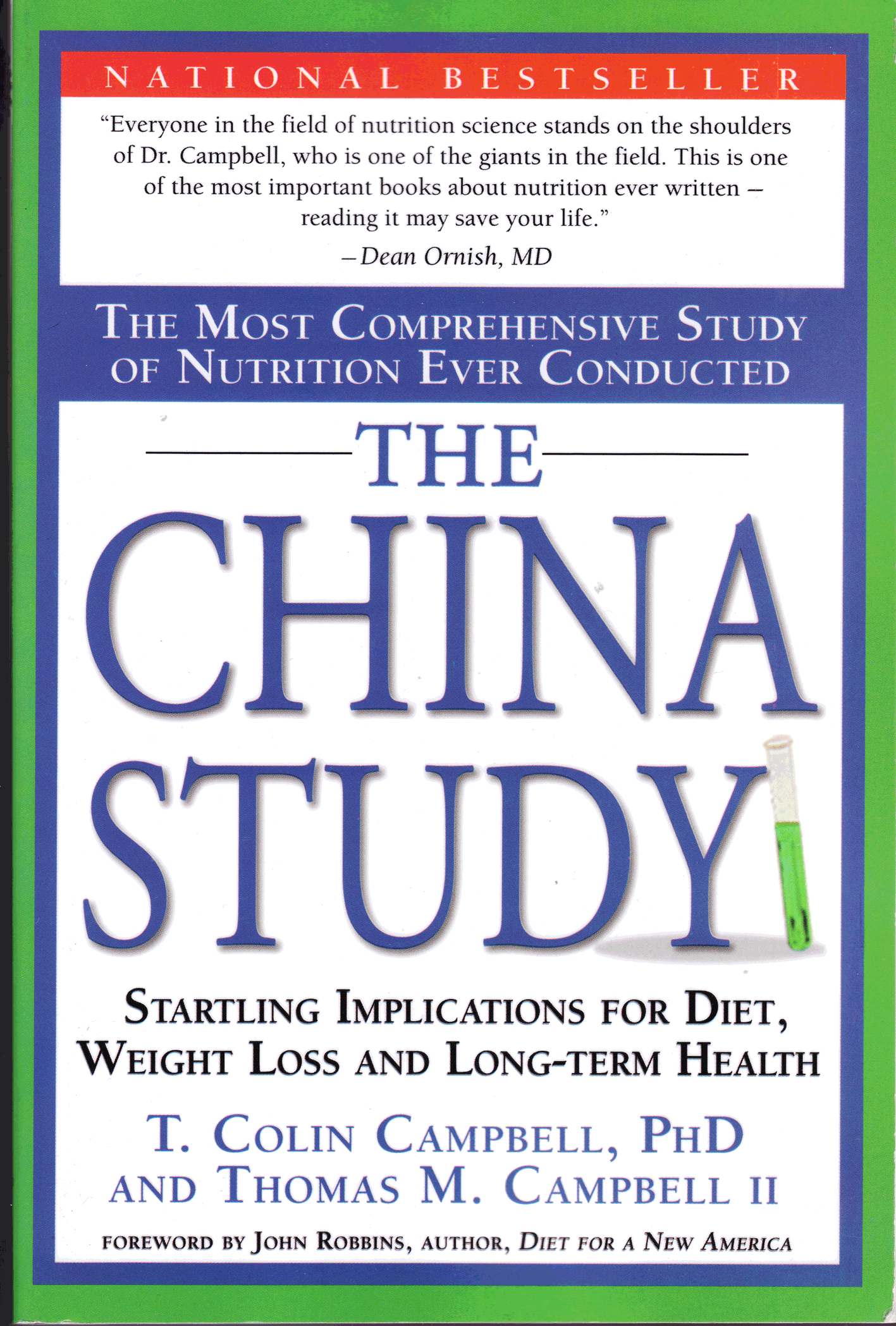
And it's this darned book, The China Study, that's getting to me. There are many other nutrition books out there that have claimed the same thing for a long time. But the actual China study, which I'll tell you about in a moment, offers some pretty convincing science.
The prevailing nutritional wisdom of my growing up years was that you couldn't grow big and strong if you didn't eat your meat, or at least drink your glass of milk with every meal - and dessert. In my child-mind I thought that glass of milk would somehow cancel out the ill-health effects of the cookies. (Yipes, this news is getting worse all the time...) We've all seen the advertisements featuring some strapping athlete sporting a white mustache, telling us to drink our milk because it does a body good. And now that we're getting older, we're told to drink our milk because it will help ward off osteoporosis.
 And we've listened. Wouldn't it make sense that those nations who consume the most milk would have the lowest levels of this bone-thinning disease? Yet the facts don't support that hypothesis, according to this article about osteoporosis in older adults, and this one about milk consumed by babies and children, and this article outlining many connections between milk consumption and osteoporosis. Any good ol' Google search will reveal article after article of evidence.
So, the China study. The author, Dr. Campbell, grew up on a dairy farm and was a farm boy through and through, even on into his days as a researcher at Cornell University. He was convinced that people needed more protein in their diets. To him and many others, protein meant animal protein. Anyway, during the early 1970s, the premier of China, Chou EnLai, was dying of cancer. During his dying days, he initiated a nationwide survey to collect information about the disease which was killing him, and which was not well understood. It was to be a survey of gigantic portions, finding the death rates for 12 different types of cancer in more than 2400 Chinese counties and 880 million (96%) of their citizens. The results showed an undeniable link that cancer was geographically localized.
Then in the early 1980s, Dr. Campbell and some of his esteemed colleagues, were able to go to China and do follow ups with a cross-section of these citizens to find out more about their lifestyles, what they ate, what was in their urine and blood, how they lived, and how they died.
The long and short of it is, counties with higher rates of animal protein consumption (specifically, casein) had the highest rates of all cancers across the board. And further tests using mice and rats (poor guys, always at the bottom of the scientific food chain, but I am thankful for them) showed that the scientists could literally turn cancer on and off by what they fed the critters. Increasing their animal protein consumption turned the cancer on, lowering it turned it off. When they tried increasing the amount of plant-based protein, cancer rates did not go up, but remained very low.
That's the quick-and-dirty primer of the study, but the book is full of much more detail, naturally, than I've got room for here. It was quite the comprehensive scientific undertaking.
There are so many things running around in my head right now, but I'm getting tired of thinking and this blog entry is getting a bit lengthy. Suffice it to say, I'm working through the implications of this whole paradigm shift.
Not the least of which is...
Now what am I going to drink with my cookies?


Oh dear.... more info to take in, process, adjust in my mind on this never ending quest for health!! thanks for sharing! (well, sort of!) ;)
ReplyDelete